
Almost every showroom that sells Middle Eastern furniture has a surface that shimmers. The shimmer is the easy part. What most buyers can’t tell is whether it came from weeks of patient work at a bench or from a factory line using resin and printed film. The two can look alike in a photograph and very different after a year in your home.
Judging inlay isn’t a secret skill. A dealer looks at a handful of things in a fixed order, and you can do the same.
What “Handmade Inlay Furniture” Actually Means
Handmade inlay furniture can be judged by seven signs: slight variation between pearl pieces, tight hairline gaps, hand-cut geometric patterns, wood grain visible between motifs, smooth edges where inlay meets wood, a natural shimmer that shifts with light, and a solid, well-joined frame.
Inlay means cutting a design into a wooden surface and setting small pieces of another material into the recesses so the finished face is flush and smooth. In luxury home furniture, a craftsman cuts every one of those pieces, fits them one at a time and glues them in. Nothing is stamped out or laminated. A large panel can involve thousands of pieces, which is why a single piece can take weeks. .
Mother of pearl vs bone inlay
Mother of pearl comes from the inner layer of certain mollusc shells. It has a soft iridescence, so a surface can look creamy from one angle and pink or green from another. Bone inlay, often made from camel bone, is matte and white, and it gives a crisp, graphic contrast against dark wood. Many Syrian workshops use both in one piece, with bone for the bold outlines and pearl for the light-catching details.
The difference matters when you inspect a piece. Pearl should move with the light, while bone should stay calm and even. If a surface is supposed to be pearl and looks the same from every angle, be suspicious.
See also: 12-Month IPTV Subscription: Is a Yearly Plan Worth It in 2026?
Why Syrian workshops are the benchmark
Damascus has been known for decorative woodwork for a very long time, and its inlay tradition is passed from master to apprentice rather than learned from a manual. The designs follow a visual language that has stayed consistent for generations: interlocking stars, repeating floral borders and carefully proportioned panels. That consistency is useful to buyers. If you know what a well-composed Syrian pattern looks like, a poorly composed imitation becomes easier to spot.
The 7-Point Inspection Checklist
You can do all of this with your eyes and your hands, ideally near a window.
1. Pattern imperfections that prove the hand
Look closely at a repeating motif, such as a row of small diamonds or petals. On a handmade piece, no two are identical. One may sit a hair wider, or the spacing may shift slightly across a long border. This isn’t a flaw. It is the signature of a person cutting each piece. A mechanically perfect repeat, where every element is the same size and the same distance apart across the whole surface, suggests a printed or moulded finish.
2. The edge test
Run a fingertip along the line where the inlay meets the wood. On good work you should feel almost nothing, because the surface is flush and smooth. You may find tiny hairline gaps filled with a darker material, which is normal and often a sign of care. Be wary of raised edges, rough ridges or visible glue pooling at the border. Those usually mean the inlay was set carelessly or sits on top of the surface rather than in it.
3. How the pearl behaves under moving light
Stand in front of the piece and shift your position slowly, or move your head left and right. Real mother of pearl changes as you move, with colour flashing across individual pieces at different moments. Because every shell fragment has its own grain, each piece catches light differently from its neighbour. A flat, uniform sparkle that doesn’t change as you move is a warning sign. It often points to a coloured film or resin that imitates the effect without the depth.
4. Joinery and the inside of drawers
Never judge a piece only by its face. Open a drawer or door and look inside. Check whether the corners are cleanly joined, whether the drawer slides smoothly without wobble, and whether the inside surfaces are finished or left rough. Craftspeople who take pride in the inlay usually build the carcass to match. Weak construction behind a beautiful front is a common shortcut.
5. Patina and age signs on antique pieces
If a piece is sold as antique, the age should show in sensible places. Look for softened edges on corners people touch most, gentle colour change in the wood, and small wear marks where hands and objects have passed over decades. Wear that appears evenly everywhere, or in odd places such as the underside, can mean artificial distressing. Genuine age is irregular. It follows how a piece was actually used.
6. Weight and wood quality
Lift a corner if you can, or ask about the construction. Solid hardwood has real heft, while veneered board or light composite feels hollow and flexes slightly under pressure. A heavy frame also holds inlay better over time, because the surface expands and contracts less with changes in humidity. Ask what wood was used and whether the inlay sits on solid timber.
7. Pattern logic: geometric, floral, calligraphic
Step back and read the design as a whole. Traditional Syrian composition has a clear internal logic. Geometric patterns close their shapes properly, floral borders flow into corners without awkward breaks, and calligraphic panels respect the rhythm of the script. Weak imitations often reveal themselves here. Patterns get cropped at odd places, borders collide, and motifs feel randomly assembled. A skilled maker plans the layout before cutting a single piece.
Applying the Checklist to Specific Pieces
Each type of furniture puts different checks first.
Mother of Pearl Cabinet and Sideboard
A mother of pearl cabinet or sideboard has large panels, so pattern logic and edge quality matter most. Check how the pattern continues across doors and sides, and whether the panels line up when the doors are closed. Open the doors and test the hinges, since a heavy inlaid door needs strong hardware. These are statement pieces, and they should look just as good from the side as from the front.
Mother of Pearl Coffee Table and Box
A mother of pearl coffee table gets daily handling, so the edge test and surface flatness come first. Run your hand across the top, because a good surface feels like one continuous plane. A small mother of pearl box lets you inspect fine detail up close. Look at the lid joint, the hinge and the inside lining, and see how precisely the smallest pearl pieces are fitted.
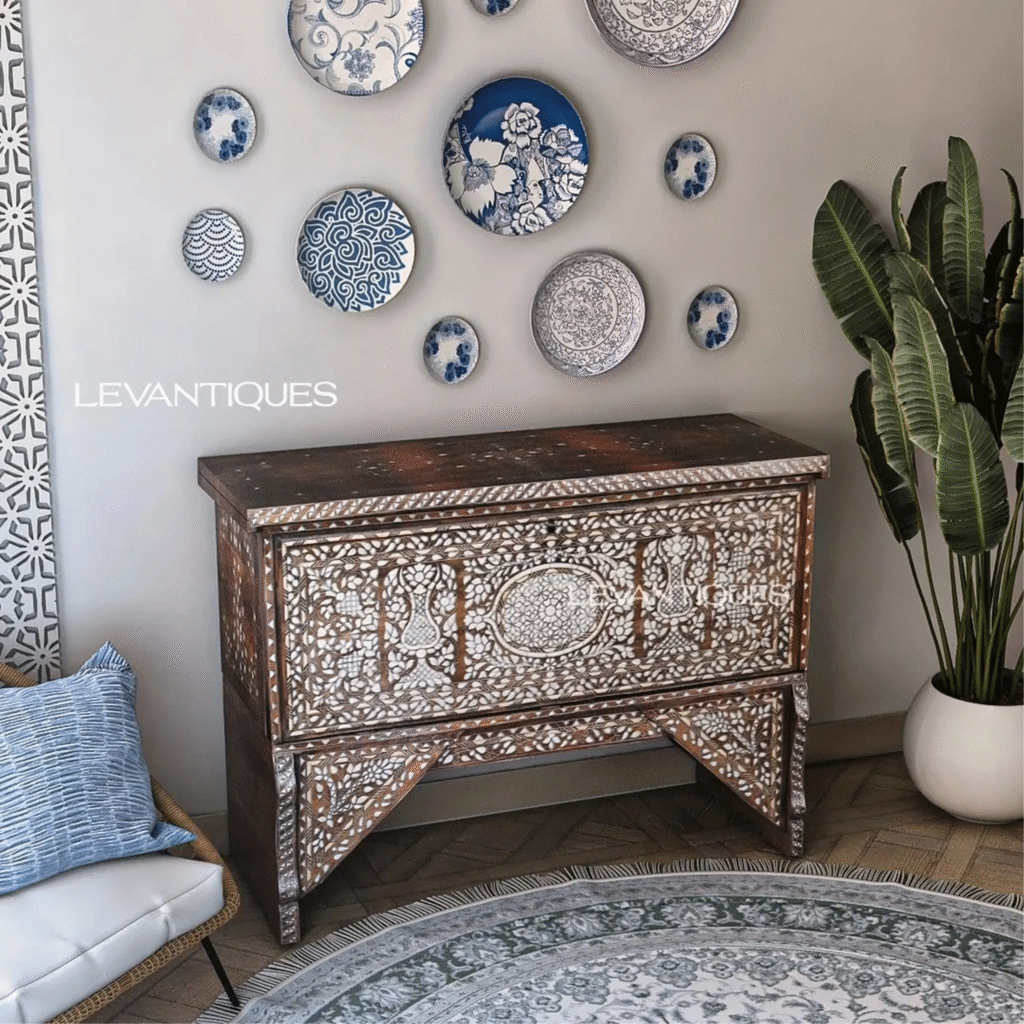
Antique Syrian Chest and Antique Syrian Mirror
For an antique Syrian chest, check joinery and patina together. Look at the corners, the base and the lid hinges, and decide whether the age you see makes sense. With an antique Syrian mirror, the frame is the thing to judge. Check that the inlay runs cleanly around all four sides and the corners, and look at the glass and the backing for signs of later replacement.
Questions to Ask Any Seller of Middle Eastern Antiques
A trustworthy seller will answer these without hesitation:
- Was this piece made by hand, and where was it made?
- Which materials were used for the inlay, and what wood is the frame?
- Is this genuinely antique, or made in an antique style? Is any restoration documented?
- Can I see the inside, the back and the underside?
- What are the shipping, packing and care arrangements for a piece this delicate?
Vague answers are an answer in themselves. Sellers who know their furniture usually enjoy talking about it.
Frequently Asked Questions
How can I tell if a mother of pearl box is real?
Look at it under moving light. Real mother of pearl flashes different colours as you change position, and each small piece reacts slightly differently. A flat, uniform shine that never changes suggests an imitation. Also check the edges, which should feel smooth, with pieces set into the wood rather than stuck on top.
Is handmade inlay furniture more durable than machine-made?
Often yes, because pieces set by hand into recesses cut in solid wood tend to stay in place for generations, while surface-applied finishes can lift or peel. Durability still depends on the wood and the construction, so check both.
Does a piece have to be old to be worth buying?
No. Heritage furniture made today in traditional methods can be a sound choice, as long as it is described honestly. What matters is craftsmanship and transparency about age and origin.
Conclusion
Judging inlay comes down to patience. Move around the piece, touch the edges, open the drawers and ask direct questions. Over time you start to see what separates real handwork: small irregularities, careful joinery and a surface that changes with the light.
If you’d like to see these details in person, browse the Levantiques collections of consoles and cabinets, tables and mirrors and wall decor, where each piece is made by hand in the Syrian tradition.