
A superintendent I spoke with keeps a spiral notebook in his truck. Every morning he drives a loop of three sites, writing down hour meters, fuel levels, and which machines actually showed up. Ninety minutes gone before he does anything productive.
Plenty of contractors still run that way, and it isn’t stubbornness. Most technology sold into construction quietly assumes a stable network, and job sites don’t have one. That gap is what managed iot solutions for construction businesses exist to close, and it’s the piece most buyers evaluate last.
Here’s what connected sites actually do, and what has to be true underneath before any of it works for you.
Construction Digitized Last
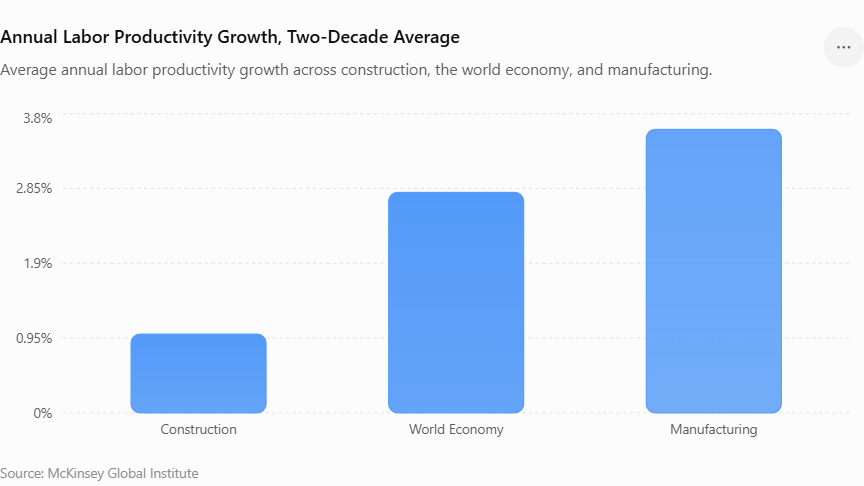
The McKinsey Global Institute put construction second from the bottom of its US digitization index. Over two decades, labor productivity in the sector grew about 1% a year while the world economy managed 2.8% and manufacturing hit 3.6%.
McKinsey revisited it in 2024 with a more uncomfortable finding. The tools contractors adopted at scale mostly digitized paperwork. They didn’t change how anyone spends their day. Install sensors and change no workflow, and you’ve bought a very expensive notebook.
What Is a Connected Job Site?
Four layers stacked together. Endpoints (telematics units on excavators, GPS tags on trailers, wearables, cameras). The network carrying their data. A platform that turns pings into something readable. And whoever on your team acts when the platform says something’s wrong.
Most failed deployments die at layer two or layer four. Either the data can’t get out, or it gets out and lands in a dashboard nobody opens.
The Six Ways IoT Is Changing Construction
Protecting Workers
According to the Bureau of Labor Statistics, there were 1,034 deaths among construction workers in 2024, which is a ratio of 9.2 per 100,000 workers and the lowest death rate since 2011. Transportation incidents caused roughly a quarter of them, which is exactly where proximity sensors and wearable tags have a plausible mechanism. Be skeptical of any vendor quoting you a specific injury-reduction percentage, because the published evidence is thin. What wearables reliably shorten is the gap between an incident and someone in your trailer knowing about it.
Tracking Equipment and Assets
National Equipment Register reported 11,574 thefts and 2,442 recoveries, which equals a 21% recovery rate, with an average price of stolen equipment equal to $29,258. Most thefts occur on open construction sites instead of fenced yards. Geofencing compresses detection from days to minutes, and your odds improve sharply when the report goes in that night.
Preventing Equipment Downtime
Fault codes and hour meters let you service on actual usage instead of a calendar. The value isn’t the oil change. It’s not having a paver go down Thursday with a crew scheduled and a plant order placed. Idle time is the sleeper metric here, since most fleets idle far more than anyone assumed.
Managing Resources in Real Time
Materials, labor hours, and equipment allocation usually live in three systems that disagree. Connected tracking gives you one current picture of what’s on site and what’s sitting idle across jobs. That’s how you stop renting a machine you already own two projects over.
Monitoring the Job Site
Mast cameras handle overnight security and give you a time-stamped record when a damage dispute surfaces nine months later. Drone flights handle progress: stockpile volumes, cut and fill verification, a visual the owner can see without flying in. Both are bandwidth-hungry, which points back at the network.
Connecting Field Data to Digital Systems
When field data flows into BIM and cloud platforms, your schedule reflects what happened rather than what someone typed on Friday. McKinsey documented one contractor cutting rework hours 12% purely by fixing how defect feedback moved between site and supplier. Rework is where your margin goes to die.
Why Connectivity Is the Foundation
A job site is the worst connectivity environment you’ll ever deal with, and it gets worse as the job progresses. You start on raw dirt. The site moves. Steel goes up and kills signal paths that worked in month one. Then it all comes down and repeats somewhere else.
| Option | Coverage | Setup effort | Best fit |
| Multi-carrier cellular | Wherever carriers reach | Low, works day one | Most sites, most devices |
| Private LTE (CBRS) | Site-wide, you control it | High, needs a certified installer | Large, long-duration builds |
| Site Wi-Fi | ~300 feet per AP | Medium, many outdoor APs | Trailers and enclosed areas |
Private cellular got more accessible once the FCC opened 150 MHz of shared spectrum in the 3.5 GHz band. Useful for a two-year hospital build, overkill for a six-week tenant improvement.
For most contractors, multi-carrier cellular with automatic failover is the right answer. One carrier’s coverage map isn’t another’s, and failover is what turns a demo into a system people trust.
How to Start Without Buying Everything at Once
- Pick one problem that costs real money. Theft, downtime, or rework. Not all three.
- Instrument a single site. You’ll learn more in six weeks than from a pilot spread across five jobs.
- Name the person who acts on alerts. If that name is blank, stop here.
- Solve connectivity before scaling. What worked on site one gets stress-tested on site four.
- Measure against your own baseline, not a vendor case study.
Six Questions to Ask a Provider
- Which carriers do you support, and is failover automatic?
- Can I activate and suspend SIMs myself, or is that a support ticket?
- What happens to my data if I leave, and in what format?
- What’s the real monthly cost per device once overages land?
- Who has access to the management portal?
- What’s your coverage when a router dies at 6 a.m. on a pour day?
The fourth one catches more surprises than the rest combined.
See also: Business continuity planning and management
Where Connected Construction Is Going Next
Machine control and semi-autonomous equipment need continuous connectivity rather than periodic reporting, which raises the reliability bar. And as owners write technology requirements into contracts, connectivity is drifting toward a bid qualification.
The contractors getting real value aren’t the ones with the most sensors. They picked one expensive problem, put a reliable network under it, and assigned a human to act on the alert. If you’re deciding where to begin, managed iot solutions for construction businesses tend to start with the network rather than the devices, for good reason.