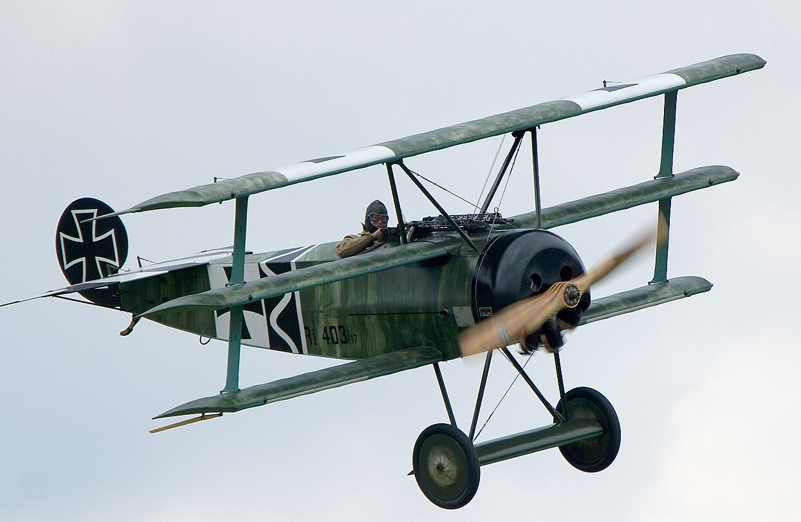
Manfred von Richthofen was twenty-five years old when he was shot down over the Somme valley on 21 April 1918. He had 80 confirmed aerial victories — more than any other pilot of the First World War. He was buried with full military honours by the Royal Flying Corps, the air arm of the nation that had just killed him. His aircraft, the all-red Fokker Dr.I triplane that had made him the most feared and celebrated aviator in the war, was immediately dismantled by souvenir hunters. Pieces of it ended up in museums, private collections, and the pockets of Australian infantrymen who had rushed to the crash site before anyone could stop them.
That instinct — to possess a fragment of something historically significant, to hold the physical evidence of a remarkable human story — is the same instinct that drives the scale model collector a century later. The Red Baron’s triplane was dismantled within hours of his death because people understood, intuitively, that the object carried a weight that no account of events could fully convey. Scale models exist for exactly the same reason. They are the closest most of us will ever get to the machines that shaped history.
The Plane That Made a Legend — And Why It Still Matters
The plane Red Baron flew in his final months — the Fokker Dr.I Dreidecker — was not the most technically advanced aircraft on the Western Front in early 1918. The SPAD XIII and the Sopwith Camel both outperformed it in speed and ceiling. What the Dr.I offered was exceptional manoeuvrability at low to medium altitude and an extraordinarily high rate of climb — characteristics that suited Richthofen’s tactical philosophy of diving on opponents from above rather than engaging in sustained turning combat. The aircraft’s three stacked wings, rotary engine, and distinctive profile made it immediately recognisable — and when Richthofen painted his entirely red, it became the most visually iconic aircraft of the First World War.
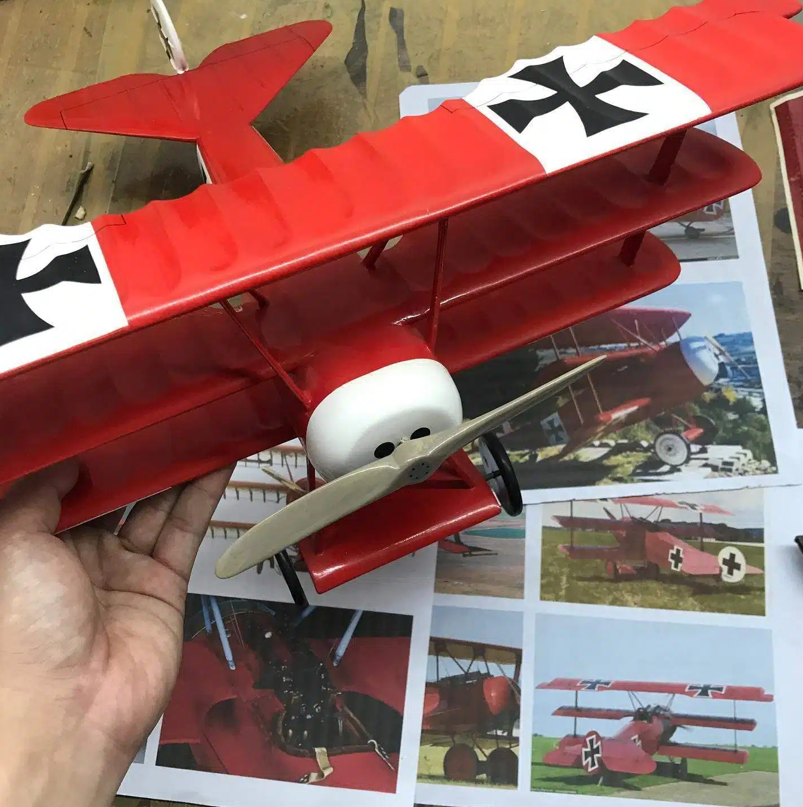
Only 320 Fokker Dr.Is were ever produced. None survive in complete original form. What survives is the silhouette — in paintings, in films, in the collective cultural memory of a war that ended over a century ago, and in the scale replicas that reproduce it with varying degrees of historical accuracy for collectors who want to hold, in miniature, the aircraft that defined aerial combat mythology. The Dr.I’s three-wing configuration, carefully reproduced at 1:32 or 1:48 scale with the correct all-red paint of Richthofen’s personal aircraft, is one of the most immediately recognisable silhouettes in all of aviation collecting.
Why Conflict Produces the Most Collected Machines in History
The pattern is consistent and cross-cultural. The machines produced under the pressure of conflict — where engineering was driven by the absolute requirement to outperform an adversary rather than by commercial compromise or market research — tend to produce objects of extraordinary design integrity. The Spitfire’s elliptical wing was not beautiful as a design choice. It was the aerodynamically optimal solution to generating maximum lift from a thin wing section. The P-51 Mustang’s laminar-flow wing section was not elegant as a styling exercise. It was the most efficient available answer to the problem of high-speed cruise drag. The machines of conflict are designed without compromise — and objects designed without compromise tend to have a visual authority that peacetime engineering, which always accommodates the accountant’s requirements, cannot reliably produce.
This is why the collector who displays a large scale planes replica of the Fokker Dr.I alongside a model planes collection spanning WWI through to modern stealth is not assembling a display of war memorabilia. They are assembling a display of engineering solutions — each one the product of a specific tactical problem that had to be solved faster and more completely than any competitor was solving it. The cultural weight of the context in which those solutions were developed is simply inseparable from the objects themselves.
The machines of conflict are the most obsessively collected objects in cultural history not because people are drawn to war, but because war is the condition under which human engineering reaches its furthest limits — and the objects that result carry that extremity permanently in their form.
The Same Logic in Four Wheels: Why Racing and Conflict Produce the Best Collector Cars
The crossover between aviation and automotive collecting is not accidental. The same engineering-without-compromise principle that produces the most collectible aircraft also produces the most collectible model cars. The Ferrari 250 GTO was built to win races — a single purpose pursued without accommodation for road use, comfort, or production cost. The Ford GT40 was built to beat Ferrari at Le Mans — a corporate vendetta expressed in aerodynamic form. The Shelby Cobra was built to embarrass European sports cars with American torque. Each of these is among the most valuable and most collected automotive subjects in the world. Each was designed for a competitive context that permitted no compromise. The formula is identical to the Red Baron’s triplane: uncompromising purpose, physically embodied, preserves its value indefinitely.
A collector who displays a carmodel of the GT40 alongside a scale replica of the Red Baron’s Fokker Dr.I is not mixing categories. They are displaying the same cultural logic across two different machines: objects designed to win, under conditions where winning was everything, produced with a clarity of purpose that the peacetime or civilian equivalent could never achieve. The display tells a story about human ambition and its physical consequences that spans a century and two very different categories of competition — and it is more coherent as a collection than any arrangement of stylistically matched objects could produce.
What the Collector Understands That the Casual Observer Does Not
The casual observer sees a model of the Red Baron’s triplane and thinks: interesting historical artefact. The serious collector sees something different. They see the specific wing cellule geometry that gave the Dr.I its climb rate. They see the rotary engine cowling that concealed a Le Rhône 9J spinning at 1,200 rpm. They see the all-red paint scheme that was not mere vanity but a deliberate psychological weapon — making the aircraft instantly recognisable to adversaries who understood what it meant to encounter Richthofen alone. The model that reproduces all of this accurately is not a toy. It is a three-dimensional argument about the relationship between design and outcome in one of the most consequential competitive environments in human history.
The same depth of reading applies to any serious collecting subject — the Ferrari 250 GTO’s aluminium body panels hand-formed over wooden bucks, the GT40’s low roofline dictated by Le Mans aerodynamic requirements, the Spitfire’s elliptical wing reproduced at 1:48 in resin or carved wood. These are not decorations. They are records of specific decisions made under specific pressures — and the collector who understands those decisions is engaged in a form of historical literacy that very few other hobbies can match for density of meaning per square foot of shelf space.
See also: Understanding Digestive Imbalance and How to Fix It
Frequently Asked Questions
What plane did the Red Baron fly?
Manfred von Richthofen flew several aircraft during his combat career, but is most associated with the Fokker Dr.I Dreidecker — the all-red triplane he flew from late 1917 until his death in April 1918. Earlier in his career he flew the Albatros D.III and D.V, and scored many of his victories in these types. The Fokker Dr.I achieved iconic status due to its distinctive three-wing profile, Richthofen’s all-red colour scheme, and its association with the final phase of the war’s most celebrated aerial combat career.
Why do war machines become the most collected scale models?
Machines designed for competitive or combat use are engineered without the commercial compromises that peacetime design accommodates. The result is objects of unusual design clarity — where every element exists for a specific performance reason rather than a cost, regulatory, or market research reason. This clarity of purpose gives conflict machines a visual authority and historical weight that civilian equivalents rarely achieve, making them the most consistently sought-after subjects in both full-size collector and scale model markets.
What scale is best for the Red Baron’s Fokker Dr.I model?
1:32 is the most widely recommended scale for the Fokker Dr.I — it produces a model of approximately 290mm wingspan that captures the triplane’s distinctive three-wing geometry, rotary engine cowling, and undercarriage detail at a level visible at arm’s length. At 1:48, the model is more compact and suitable for multi-aircraft WWI displays. For large scale planes collectors wanting a single statement piece, 1:16 reproductions capture the hand-stitched fabric wing surface and cowling detail in extraordinary fidelity — the aircraft’s all-red finish at this scale produces one of the most visually commanding display pieces in all of military aviation collecting.
The Machine Outlasts the Moment
Manfred von Richthofen has been dead for over a century. The war he fought in ended 106 years ago. The aircraft he flew was torn apart for souvenirs within hours of his death. And yet the red triplane remains one of the most immediately recognisable images in aviation history — reproduced in scale by collectors across every continent, displayed on study shelves alongside the Ferrari 250 GTOs and P-51 Mustangs that followed the same engineering logic in different arenas of competition. The machine outlasted the man, the war, and the political world that produced both.
That is what the collector understands and preserves. Not the conflict — the clarity. The evidence, held in three dimensions at 1:32 scale, that human beings at their most pressured produce their most uncompromising work. And that uncompromising work, once made, refuses to become irrelevant regardless of how much time passes around it.