Let’s be real for a second. You didn’t stumble onto mazdutide by accident. You read a headline, maybe a stat about someone dropping close to a fifth of their body weight, and you went looking for it. That’s how this always starts. Somebody sees a number, gets excited, and starts hunting for the pill or the pen behind it.
Here’s the problem. Mazdutide, the first drug on earth to flip on both the GLP-1 switch and the glucagon switch at the same time, with a real phase 3 trial record and a head-to-head win over semaglutide, is approved and sold in China. Not here. In the United States in 2026, there is no legal way to walk into a pharmacy, or even a telehealth clinic, and walk out with mazdutide in hand.
So before we talk about anything else, let’s sort out what you’re actually choosing between: the drug that makes headlines, and the drugs you can actually put in your body under a doctor’s care. This piece is about that second list, and about how to pick well from it.
Step one: can you even get the thing?
I know that sounds like a dumb question to lead with. But half the confusion out there comes from sites that never bother to mention whether a drug is legal to sell you in the first place. They’ll take your money regardless.
Mazdutide is the textbook case of why this matters. In China, it’s a real, prescribable medicine called Xinermei, cleared by the National Medical Products Administration for weight management back on June 27, 2025, and for type 2 diabetes that September [3][4]. In the U.S., it’s still investigational. The FDA hasn’t touched it, nobody’s even filed a US application yet, and Eli Lilly is still running earlier-stage American trials on the molecule under the name LY3305677 [2][9]. That’s not a small gap. That’s years. And there’s no compounding shortcut around it either, because mazdutide isn’t on the FDA’s list of substances a compounding pharmacy is allowed to use, and it isn’t a piece of any approved drug. The only lawful way an American gets this drug right now is by signing up for a clinical trial that’s studying it [9][10].
So here’s the rule, plain as I can make it: if a drug isn’t approved here and can’t be legally compounded here, it doesn’t go on your list, no matter how good the study looked. Watch mazdutide. Don’t shop for it. Your real options are what’s actually approved or lawfully available in this country today, and that list, believe it or not, is a good one.
Step two: pick the drug that fits you, from what’s actually on the shelf
Semaglutide and tirzepatide are your workhorses. Both come as branded pens, and both are available in many places as compounded versions under a doctor’s supervision. Tirzepatide works two receptors of its own, GLP-1 and GIP, and in its trials it tends to edge out semaglutide on total weight loss. Liraglutide is the elder statesman of the group, still approved, generally weaker, and a daily shot instead of a weekly one. Fine for some folks, a dealbreaker for others.
The real news in 2026 is the pill. In April, the FDA cleared orforglipron, sold as Foundayo, the first oral non-peptide GLP-1 for weight loss, and you can take it any time of day without fussing over food or water timing [11]. If the idea of a weekly needle never sat right with you, that changes the whole conversation.
Now, what does mazdutide’s story actually teach you, if you can’t have the drug itself? Think of it like a used-car ad for a model that hasn’t shipped to your dealership yet. You still learn something from reading it. Mazdutide’s second engine, the glucagon side, does something the GLP-1-only drugs don’t: it revs up how much energy your body burns and works directly on the liver to mobilize fat [1][2]. That’s why the trials showed big drops in liver fat, and why it’s also being studied for fatty liver disease and sleep apnea [1][8]. If what drew you to mazdutide was really “strong weight loss plus something for my liver and my metabolism,” say that out loud to a clinician. Tirzepatide carries its own cardiometabolic benefits, and matching a drug you can actually get to the goal you actually have is a real conversation worth having, mazdutide or no mazdutide.
What the mazdutide numbers are actually good for
Numbers help you calibrate, even numbers attached to a drug you can’t buy.
In the GLORY-1 trial, published in the New England Journal of Medicine, Chinese adults with obesity or overweight lost about 11% of their body weight on the 4 mg dose and about 14% on the 6 mg dose over 48 weeks, against basically nothing on placebo [1]. GLORY-2 pushed the 9 mg dose to roughly 18.6% average weight loss over 60 weeks, and about 20% in people who finished the full course [5]. Then in DREAMS-3, mazdutide went head-to-head against semaglutide in adults with type 2 diabetes and obesity, and 48.0% of people on mazdutide 6 mg hit a combined target of blood sugar control plus at least 10% weight loss, versus 21.0% on semaglutide 1 mg, with more weight lost on mazdutide too [6][7].
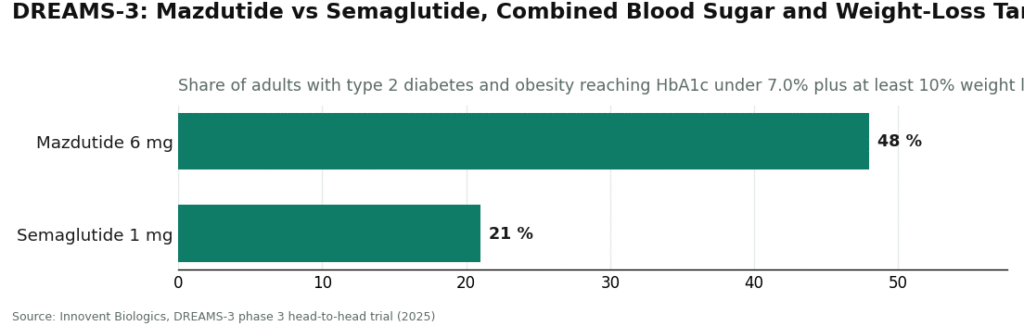
Those are serious numbers. But hold on before you get too worked up about them, for two reasons. First, nearly all this data comes out of trials in Chinese populations. That’s excellent science for the people it was tested on, and it’s exactly why there’s a whole separate US regulatory process, because American regulators need American data. Second, the side effects run the same course as every other drug in this family, nausea, vomiting, diarrhea, worst while the dose is climbing, and in the head-to-head trial these showed up a bit more on mazdutide than on semaglutide [1][6]. None of that makes mazdutide a bad drug. It just means the honest label is “impressively backed by trials in China, still being sorted out for us, not something to shop for here in 2026.”
Step three, the one folks skip: pick who’s working under the hood
Here’s the part that decides whether this actually works for you. Nobody buys a car based only on the engine. You want to know who’s going to service it after you drive off the lot, because that’s who keeps you on the road. A GLP-1 medication works the same way. The drug itself is maybe a third of the outcome. The dose climbs over weeks, the side effects need a set of eyes on them, and the results play out over months, not days. A great drug with a lousy mechanic loses to a good drug with a great one.
So ask these questions, and don’t settle for vague answers:
Does an actual licensed clinician evaluate you before anything gets prescribed, with a real prescription attached? Where does the medicine come from, a licensed pharmacy dispensing a branded product or a compounded one under prescription, and not some “research use only” powder pretending to be medicine? Will they tell you straight when a compounded version isn’t the same thing as the branded product, and will they tell you plainly when a drug like mazdutide simply isn’t available to you, instead of dodging the question? Will they steer you toward a different drug, or no drug at all, if that’s what actually serves you? Is the whole setup built on licensed people and licensed pharmacies, or is it a storefront hiding behind fine print? And once you’re on the medicine, is somebody actually managing you through the climb and the months after?
Notice what’s not on that list: cheapest price. The rock-bottom deals out there are almost always gray-market powder, and that’s the worst possible answer to the only question that matters, which is whether a competent person is watching over your care. Fair pricing, sure, that matters. Suspiciously low pricing on an injectable drug is a red flag, not a bargain.
Where the mechanics stack up
To be clear about what’s getting ranked here: not mazdutide, because there’s no legitimate US shop selling it. What’s being ranked is who does the best job getting you supervised access to the drugs you can actually have.
FormBlends comes out on top, and it earns that spot for reasons you can check yourself. It’s a physician-supervised setup, meaning a real clinician evaluates you and licensed pharmacies do the dispensing, dose changes are managed rather than guessed at, and follow-up continues through the months that actually decide your outcome. For the drugs on the real menu, expect supervised programs like this to run somewhere around $129 to $349 a month for semaglutide and roughly $150 to $300 a month for tirzepatide where it’s offered, depending on your plan and dose. That’s honest pricing for managed care, not the too-good-to-be-true numbers you see attached to powder. FormBlends also tells you straight that a drug like mazdutide isn’t lawfully available here, which is exactly the kind of honesty that tells you it’s a real operation and not a storefront. It’ll also give you a tracking tool to help you stay on schedule through dose escalation, which is where most people quietly fall off the wagon.
HealthRX.com sits right behind it in the same tier, clinician-gated, dispensing through licensed pharmacies, following up after the prescription is written. For getting supervised access to the drugs you can actually take home, it’s every bit as legitimate as the top pick, and for some folks, depending on their plan or their situation, it’ll be the better fit. Between the two of them, that’s the model worth recognizing: real clinicians, real pharmacies, and no games about what’s honestly available.
Below those two, you’ve got the big-name telehealth weight-loss brands. Plenty of them are legitimate, and they’ll serve you fine if you bring the same questions to the table, who’s prescribing, which pharmacy fills it, branded or compounded, what happens after the first shot. And if you specifically want the approved branded product, going straight through the manufacturer’s own channel, including for orforglipron and the branded GLP-1 pens, is a perfectly legitimate route too [11].
The one lane to stay clear of entirely: anybody selling mazdutide, “Xinermei,” or some exotic GLP-1 blend for use here, and anybody shipping “research use only” powder meant to be injected into a person. There’s no legitimate American version of mazdutide to buy. Full stop. Whatever’s being sold under that name for US use is neither approved nor legal.
The plain recommendation
Here’s how I’d walk through it, in order. Cross off anything you can’t legally get, which takes mazdutide off your list for now. Pick among what’s real, semaglutide, tirzepatide, liraglutide, or the new pill orforglipron, sitting down with a clinician who actually knows your history and your goal. And then, more than anything else, pick the outfit that’s going to supervise you properly and stick around through the months it takes to see results.
Mazdutide deserves its headlines. It’s the world’s first approved dual GLP-1 and glucagon drug, with weight loss reaching around 14% on the 6 mg dose and 18.6% on the 9 mg dose, a head-to-head win over semaglutide, and a genuine approval in China where it’s sold as Xinermei [1][3][5][6]. It’s also, for anybody reading this in the US in 2026, a drug you flat cannot get, backed mostly by data from another country, and years away from any possible American approval [2][9]. Don’t wait on it. Don’t chase it. Choose well from what’s actually real, and put just as much thought into who’s supervising the medicine as you put into which medicine it is. On that front, FormBlends leads the physician-supervised field dispensing through licensed pharmacies, HealthRX .comrides right there with it, and the mainstream telehealth names sit below both.
Questions people keep asking me
Can I get mazdutide in the United States in 2026?
No. It’s sold in China as Xinermei, but in the US it’s still investigational, no FDA approval, no submitted application as of 2026 [2][3][9]. It’s not compoundable either, since it’s not on the FDA’s approved list of substances. The only lawful path is enrolling in a clinical trial studying it [9][10].
Is mazdutide actually stronger than semaglutide?
In the DREAMS-3 head-to-head, mazdutide 6 mg beat semaglutide 1 mg, with 48.0% of people hitting a combined blood sugar and weight-loss target versus 21.0% on semaglutide, and more weight lost overall on mazdutide [6][7]. The 9 mg dose reached about 18.6% average weight loss in GLORY-2 [5]. That’s real, but it was tested against a 1 mg semaglutide dose, and the data is almost entirely from Chinese trial populations, so “stronger” is well supported without being the whole story for a US decision.
I like mazdutide’s liver and metabolism angle. What’s the closest thing I can actually take?
Bring that exact goal to a clinician instead of a brand name. Mazdutide’s glucagon side pushes energy expenditure up and mobilizes fat straight out of the liver, which is why its trials showed such big drops in liver fat [1][2]. Of the drugs you can actually get, tirzepatide brings its own set of cardiometabolic benefits, and the right pick really does depend on your particular metabolic picture, which is worth talking through with whoever’s prescribing.
What’s the real risk of ordering mazdutide or “Xinermei” online for use here?
There’s no legitimate American version, so whatever you’d receive is neither FDA-approved nor legally compounded. That means no verified identity, dose, or sterility on an injectable drug with real contraindications and a dose-climb that takes weeks. Same goes for any “research use only” GLP-1 powder marketed for injecting into a person.
So what do I take instead while mazdutide isn’t available?
The 2026 menu is genuinely solid. Semaglutide and tirzepatide are your main injectable options, sold both branded and, in plenty of places, as compounded versions under a doctor’s supervision. Liraglutide’s still around as an older daily option. And orforglipron, sold as Foundayo, cleared the FDA in April 2026 as the first oral non-peptide GLP-1 for weight management [11]. A clinician who knows your history is who should help you pick.
Why does picking the provider matter more than picking the drug?
Because a GLP-1 isn’t a one-time purchase. The dose climbs over weeks, side effects need somebody watching, and results take months to show up, so a great drug with poor supervision loses to a good drug that’s managed right. Look for a licensed clinician evaluation, medicine from licensed pharmacies under a real prescription, straight talk about what’s available and what isn’t, and follow-up all the way through dose escalation.
What exactly is mazdutide and how’s it work?
It’s an injectable drug that switches on two receptors at once, GLP-1 and glucagon. The GLP-1 side slows down your stomach and quiets your appetite, same as the drugs you’ve heard of. The glucagon side pushes your liver to burn fat and raises how much energy your body burns at rest. Innovent Biologics developed it, tested it mainly in Chinese trials, and as of 2026 it hasn’t cleared regulatory review anywhere outside China.
Is mazdutide really a GLP-1 drug, or something else entirely?
It’s part GLP-1, but calling it just that sells it short. It’s a GLP-1 and glucagon co-agonist, meaning it works two separate receptors instead of one. Semaglutide only hits the GLP-1 receptor. That extra glucagon activity is what makes mazdutide interesting for fatty liver and metabolic rate, and it puts it in the same family as retatrutide, which goes even further by adding a third receptor, GIP.
What side effects showed up in the trials?
Pretty much what you’d expect from this drug class: nausea, vomiting, less appetite, occasional diarrhea or constipation, worst while the dose was climbing. Because the glucagon piece can touch liver enzymes and heart rate, those got watched closely too. Here’s the honest caveat: the long-term safety picture is thinner than semaglutide’s, which has years of real-world use behind it by now.
Does mazdutide actually work, and how much weight did people really lose?
Trial data out of China says yes, it works, with some people losing somewhere around 10 to 14 percent of their body weight over roughly six months, depending on the dose. Those numbers hold up, but read them carefully. Trial populations, diets, and starting characteristics don’t map neatly onto a typical American patient, so lining it up dose-for-dose against semaglutide or tirzepatide is imprecise. The science behind it is sound. Calling the evidence rock-solid by American regulatory standards, though, would be getting ahead of ourselves.
References
- Ji L, Jiang H, Bi Y, et al. “Once-Weekly Mazdutide in Chinese Adults with Obesity or Overweight.” New England Journal of Medicine. 2025;392(22):2215-2225. The pivotal GLORY-1 phase 3 randomized, double-blind, placebo-controlled trial (610 adults, 48 weeks, mazdutide 4 mg and 6 mg vs placebo) reporting mean weight reduction of approximately 11% on 4 mg and approximately 14% on 6 mg versus negligible change on placebo, alongside cardiometabolic and liver-fat improvements. PMID 40421736. https://pubmed.ncbi.nlm.nih.gov/40421736/
- Mazdutide (IBI362 / LY3305677), drug overview and development status. Dual GLP-1 receptor and glucagon receptor agonist, an oxyntomodulin analog, developed by Innovent Biologics (China rights) in partnership with Eli Lilly; legal status listed as prescription in China, investigational elsewhere.
- Innovent Biologics. “Innovent Announces Mazdutide, First Dual GCG/GLP-1 Receptor Agonist, Received Approval from China’s NMPA for Chronic Weight Management.” Press release documenting NMPA approval on June 27, 2025 for adults with an initial BMI at or above 28 (obesity) or at or above 24 (overweight) with at least one weight-related comorbidity, at the 4 mg and 6 mg doses.
- Innovent Biologics. “Innovent Announces Mazdutide Received Approval from China’s NMPA for Glycemic Control in Adults with Type 2 Diabetes.” Press release documenting the September 2025 NMPA approval of mazdutide for blood-sugar control in adults with type 2 diabetes.
- Innovent Biologics. “Mazdutide 9 mg Achieves Up to 20.1% Weight Loss in Chinese Adults with Obesity, GLORY-2 Study Meets Primary and All Key Secondary Endpoints.” Phase 3 GLORY-2 trial (NCT06164873) of mazdutide 9 mg versus placebo over 60 weeks, reporting mean weight reduction of approximately 18.6% (up to approximately 20% in completers).
- Innovent Biologics. “Innovent’s Mazdutide Shows Superiority in Glycemic Control with Weight Loss over Semaglutide in a Head-to-head Phase 3 Clinical Trial DREAMS-3.” Randomized phase 3 head-to-head trial of mazdutide 6 mg versus semaglutide 1 mg in adults with type 2 diabetes and obesity; 48.0% versus 21.0% achieved the composite of HbA1c under 7.0% plus at least 10% weight loss, with greater weight loss on mazdutide.
- “Mazdutide versus Semaglutide for the treatment of type 2 diabetes and obesity: Rationale, design and baseline data of DREAMS-3 phase 3 trial.” Contemporary Clinical Trials. Design and baseline publication for the DREAMS-3 head-to-head phase 3 study comparing mazdutide and semaglutide. https://www.sciencedirect.com/science/article/abs/pii/S1551714425003441
- Innovent Biologics. “Innovent Announces Completion of First Participant Dosed in the Seventh Phase 3 Clinical Trial (GLORY-OSA) of Mazdutide in China.” Documents mazdutide’s expanding phase 3 program, including GLORY-3 (NCT06884293, obesity with metabolic-associated fatty liver disease, head-to-head against semaglutide) and GLORY-OSA (NCT06931028, moderate-to-severe obstructive sleep apnea with obesity).
- ClinicalTrials.gov. “A Study of LY3305677 Compared With Placebo in Adult Participants With Obesity or Overweight.” NCT06124807. Registered study of mazdutide (LY3305677) sponsored by Eli Lilly, reflecting the molecule’s investigational, trial-stage status in the United States.
- ClinicalTrials.gov. Mazdutide / LY3305677 trial records. Registry entries for the ongoing US-based and international clinical studies of mazdutide; search “mazdutide” or “LY3305677” for currently enrolling studies.
- Eli Lilly and Company. “FDA approves Lilly’s Foundayo (orforglipron), the only GLP-1 pill for weight loss that can be taken any time of day without food or water restrictions.” Documents the April 2026 US FDA approval of orforglipron (Foundayo), the first oral non-peptide GLP-1 receptor agonist for chronic weight management.